


Complete perineal tear, a taboo scar
"Simple" perineal tears (stages 1 and 2) have been increasing in recent years (51% in 2016 compared to 58.8% in 2021), while severe tears, known as "complicated complete perineal tears" (stages 3 and 4), remain rare (0.8% in 2016, compared to 1.1% in 2021).
✔️What is "a complete perineal tear"?
During childbirth, pushing can lead to trauma to the pelvic floor. Perineal lesions of varying depths can occur in the vulva and on the perineum, the muscle (among others) located between the vagina and the anus.
To understand a perineal tear, you need to know the different anatomical layers that make up the perineum at the site of the tear:
- vaginal mucosa
- the central fibrous core of the perineum
- the external anal sphincter
- the internal anal sphincter
- the anorectal mucosa

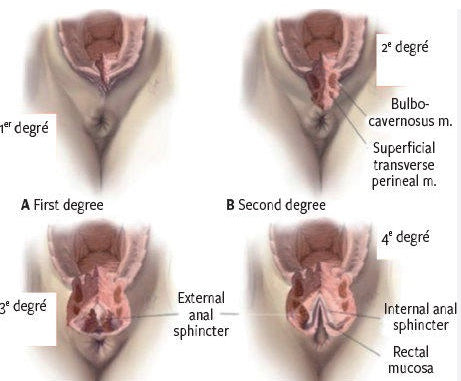
The severity of a perineal tear, which varies depending notably on its depth, is classified into 4 degrees of severity:
1. "Simple" perineal tear:
- 1st degree: only the skin and vaginal mucosa are affected
- 2nd degree: the skin and vaginal mucosa + perineal muscles are torn
2. Uncomplicated complete perineal tear:
- 3rd degree: the skin and vaginal mucosa, perineal muscles + the anal sphincter are torn
3. Complicated complete perineal tear:
- 4th degree: the skin and vaginal mucosa, perineal muscles , the anal sphincter + the rectal mucosa. Degree 4 is the most severe because the tear extends to the anal mucosa, creating a communication between the vagina and the anus.
"A tear of the anal sphincter can notably lead to faecal and urinary incontinence, as well as sexual dysfunction, which are exacerbated by the anatomical and functional interdependence of the pelvic floor organs. These consequences affect women's quality of life." (source: Swiss Medical Journal)
✔️What are the risk factors?
What are the risk factors for a complete perineal tear:
- Primipara: giving birth for the first time (the perineal muscles have never delivered a baby)
- Instrumental extractions
- Prolonged expulsion phase
- Fetal macrosomia > 4 kg
- Occipito-posterior presentations or "malpresentation of the fetus"
- Median episiotomies (vertical incision of the vagina to the rectum)
- Shoulder dystocia and the maneuvers it involves
✔️What suture?
Depending on the severity of the tear, several techniques can be performed:
- Degree 1 and 2: Unless a particular need is established in the operating room by the healthcare professionals, it will be sutured with standard absorbable synthetic thread or fast-absorbing thread.
- Degree 3 and 4: suturing techniques vary depending on the severity and depth of the tear
✔️What scar?
- The stitches may take between 10 days and 6 weeks to fully absorb. Healing time varies depending on the suturing technique and whether the threads are absorbable or not.
- Medical intervention is essential for the management and follow-up of degrees 3 and 4.
- In all cases, the scar will undergo a minimum remodeling of 24 months
✔️How to find relief?
To relieve a scar and perineal pain, it may be useful to:
- Consult at the slightest persistent pain
- Consult at the slightest hesitation (redness / heat / pain)
- Apply cold to the area if it is swollen and/or painful (there may also be oedema)
- Use innovative Wounded Women lingerie to support the belly "upwards" and help preserve the perineum (unlike compression garments that crush the organs downwards)
- Limit standing and sitting positions during the first few days
- Reserve walking for strictly necessary travel during the first few weeks
- Use a small float if necessary to avoid crushing the painful area for the necessary time
- Avoid heavy loads (or even ban them depending on the severity)
Our Amandine model was specifically designed with patented technology to relieve pain related to perineal scars.

❤️ Our bonus tips:
1. As the stitches heal, they can cause pulling with skin retraction: in this case, you must ask a midwife or nurse to cut the threads.
2. Ask them to draw your stitches so you can visualize and facilitate the care you will do yourself afterwards, and help your body heal without ignoring this area
3. If you know your healing regarding absorbable threads: talk to the medical team so they use suitable threads for you (e.g., if the body does not absorb the threads or, conversely, absorbs them too quickly, an appropriate thread choice will be made by the medical team).
4. Ask them to clearly explain which professionals you need to see, notably if you need to be followed by a proctologist, and perform complete perineal rehabilitation (vaginal and anal elevator muscles) to limit cases of incontinence.
In all cases, consultation with a healthcare professional is essential for follow-up. In the event of a complicated complete perineal tear, a care pathway will be recommended upon discharge from the maternity ward.


